


In Fiscal Year (FY) 2024, the Department awarded over $5.6 billion in grants and over $9.5 billion in contracts. The planning, administration, and oversight of contracts and grants continues to be a challenge for the Department as a responsible steward of taxpayer dollars.
Specifically, areas of concern for Department contracting include the execution of well-designed acquisition plans and government cost estimates, monitoring of contractors’ performance, and ensuring acquisition personnel have and exercise the necessary skills and judgment throughout the procurement lifecycle. Strengthening the contract acquisition planning process by requiring contracting officials, program owners, and contractors to discuss, determine, and agree upon specific cost details and achievable outcomes will increase the likelihood of success of the Department’s contracts and reduce unforeseen costs.
An additional challenge for the Department in contracting arises from proposed changes to the Federal Acquisition Regulations (FAR), which establish uniform policies for executive agency acquisitions. The Revolutionary FAR Overhaul initiative, launched in May 2025 in response to Executive Order (EO) 14275, Restoring Common Sense to Federal Procurement, is intended to streamline and reduce barriers in the federal contracting process. As of September 2025, 33 parts of the FAR have been updated. The Department must be diligent and increase oversight of and train its contracting staff to ensure it complies with the new regulations and rapidly changing contracting guidance.
The Department’s grants play an important role in funding law enforcement and public safety activities, assisting victims of crime, and providing training and technical assistance. The OIG’s audits continue to identify challenges related to financial management, subrecipient monitoring, and performance reporting. In addition, our investigations highlight the continuing need to be vigilant for indications of fraud by recipients of the Department’s grant funds. Each of these areas of concern is directly related to preventing wasteful use of taxpayer dollars.
According to the Department’s FY 2026 budget request, the Department intends to focus its grant funding on priority programs directly linked to combatting violent crime, protecting American children, supporting American victims of trafficking and sexual assault, and better coordinating law enforcement efforts at all levels of government. EO 14322, Improving Oversight of Federal Grantmaking, similarly states that government grants should improve American lives or advance American interests, and emphasizes the need to strengthen oversight and coordinate agency grantmaking to ensure efficacy and avoid duplication of efforts.
However, the Department has also proposed a reduction in the funding of state and local grant programs, which could adversely affect important programs, such as, for example, Emergency Federal Law Enforcement Assistance grants provided to state and local law enforcement to help mitigate costs during extraordinary emergencies. The Department’s budget proposal also plans to consolidate the Office of Community Oriented Policing Services and the Office on Violence Against Women into the Office of Justice Programs and cut 79 positions. While these proposed actions may result in cost efficiencies and streamline grants processes and programs, the Department must be attentive to potential pitfalls—such as the decrease in grant management personnel—that could result in less oversight and increase the risk of fraud and misuse of federal funds. The OIG’s audits of grant fund recipients have repeatedly demonstrated the need for the Department to carefully administer and monitor grantees.
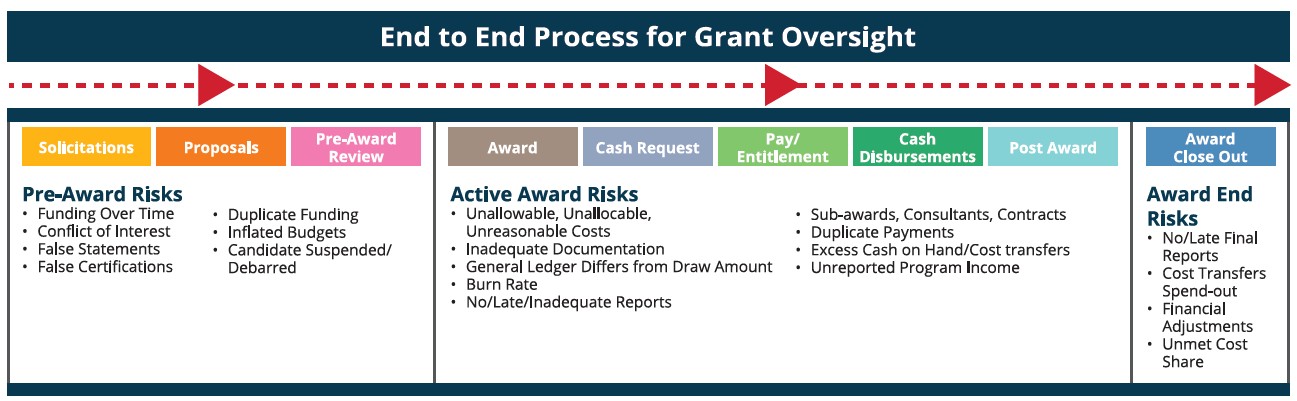
Source: CIGIE Report on Grant Oversight